





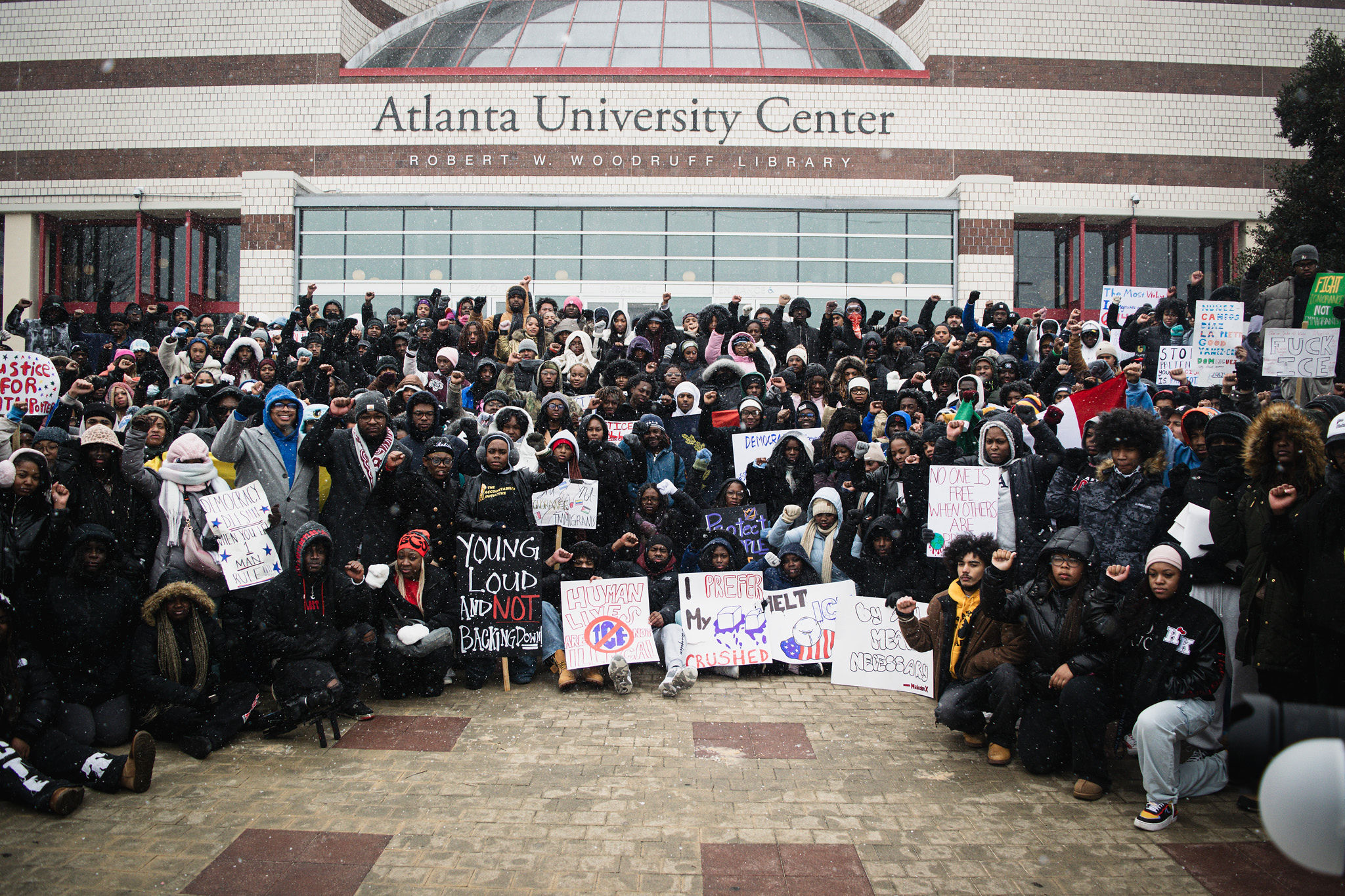
On Jan. 31, students from across the Atlanta University Center gathered to protest Trump administration immigration policies and the presence of U.S. Immigration and Customs Enforcement in cities and neighborhoods across the United States.
The protest followed renewed immigration enforcement efforts and increased ICE activity in major U.S. cities. These shifts expanded detention and deportation practices, according to organizers.
As many as 300 students from AUC institutions joined members of the broader Atlanta community. Together, they marched from the steps of the Robert W. Woodruff Library to the gates of the Georgia State Capitol.
As the group moved through the city, protesters chanted phrases such as “We want ICE off our streets” and “Immigrant lives matter.”
Once the march reached the Capitol, organizers passed around a megaphone. Participants used it to share messages and speeches on the Capitol grounds.
In addition, protesters read aloud the names of people killed during ICE encounters. The group paused after each name to honor and remember those lives.
Organizers emphasize student safety
To keep students safe, Clark Atlanta University Police Chief Debra Williams and Spelman College Police Chief Moses Perdue coordinated between institutions. Officers followed the march and temporarily blocked city traffic as students moved through snowy streets.
“Chief Williams wanted to support that we got there safely,” said Meyunna Montgomery ’29, an organizer from Clark Atlanta University. Ultimately, the protest remained peaceful. No one attempted to disrupt the march, and organizers reported no incidents.
Anger fuels the organizing effort
Organizers began planning the demonstration on Jan. 10, several weeks before the event.
For Myana Garrison, a Spelman College sophomore, the idea formed during an ordinary moment. While working out at the gym, she saw televised coverage of the death of Renée Good. ICE fatally shot Good inside her SUV in Minneapolis.
“I was outraged,” Garrison said. “What fueled it was anger.”
She added that she wanted to turn that anger into action.
“My anger had to be channeled into something positive,” Garrison said. “Something loud, Something moving, Something educational.”
Activism as a way of life
For A’Nija Hughley, a Spelman College sophomore, activism did not begin with this protest.
“From the beginning, I’ve been heavily involved in social justice and advocacy,” Hughley said.
Hughley, a St. Louis native, began writing spoken-word poetry in 2020. Her work focused on racism and police brutality. Two years later, she joined Justice for Black Girls, a group that works to address systemic injustice.
In 2023, Hughley met Ralph Yarl, a teenager later shot in the head by a white man after ringing the wrong doorbell.
“Why was Ralph shot?” Hughley said. “Due to racism, obviously.”
After the shooting, Hughley connected with organizers in Kansas City, Missouri. Together, they planned protests calling for the shooter’s arrest.
Carrying a legacy of protest
For Montgomery, the Jan. 31 march marked her 15th protest. However, it was her first time serving as an organizer.
“Being born as a Black woman in the United States is my drive,” Montgomery said. “My body is a political statement.”
The Atlanta University Center holds a long history of civil rights activism. Alumni include the Rev. Dr. Martin Luther King Jr., W.E.B. Du Bois, Ralph Abernathy and Stacey Abrams. Moreover, student activism at the AUC predates the 1960s and includes sit-ins, boycotts and mass demonstrations.
Montgomery said AUC students inherit that responsibility.
“As students who attend the AUC, we applied knowing we were stepping into that history,” she said.
Preparing together, marching together
Before the protest, students gathered on Jan. 29 at the Woodruff Library. There, they made signs featuring messages later chanted during the march.
Garrison described the sign-making as an “integral” part of the process.
Meanwhile, the protest itself reflected unity across institutions. Clark Atlanta University students, Morris Brown College students, Spelman College students and Morehouse College students marched side by side.
“My biggest takeaway was seeing the power we have as students when we stand together,” said Dawud Crooms, a Morehouse College freshman. “I hope people see that AUC students do not stand with the actions of ICE. We will never be silent in our opposition.”