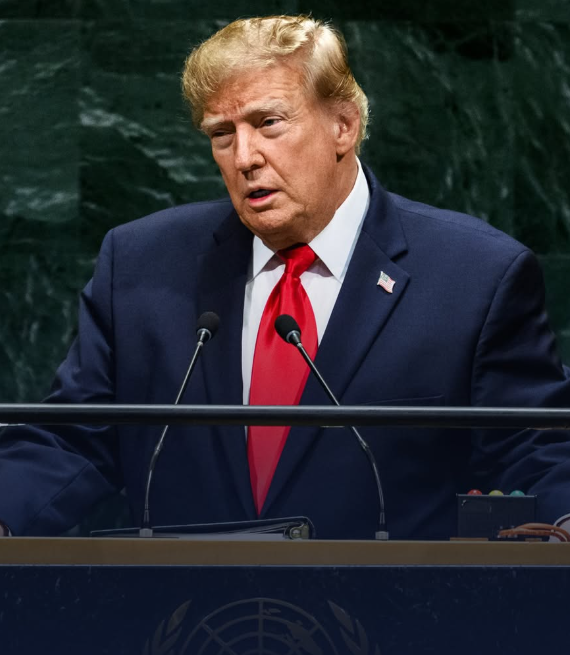






President Donald Trump has a new name for artificial intelligence (AI): super intelligence (SI). What might sound like a simple branding exercise has now become the official language of the U.S. government. This rebranding will affect diplomatic conversations with China as AI was a key topic.
Beyond Washington, however, global regulators and tech companies have spent years building policies around the term artificial intelligence. This discrepancy raises a key fundamental question: What happens when the most powerful nations in the world no longer use the same language to regulate tech policy?
The foundations of fracture
The dilemma calls attention to the Tower of Babel. The biblical story where a united people suddenly lost their shared vocabulary. Consequently, their ambitious monument project was halted. Nearly 4,000 years later, the U.S., China, and Europe are racing to shape the rules of the digital era.
Just like the ancient builders, today’s superpowers risk paralyzing technological progress if they fail to translate their competing tech policies into a single, shared global language.
In computer science, “superintelligence” designates theoretical systems that surpass all human capability. By forcing today’s commercial machine learning tools into an “SI” label, the White House has co-opted the term. For now, Trump’s change is purely linguistic. However, if “super intelligence” eventually carries a different legal definition, it could fracture an already complicated global safety debate.
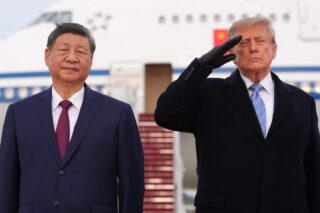
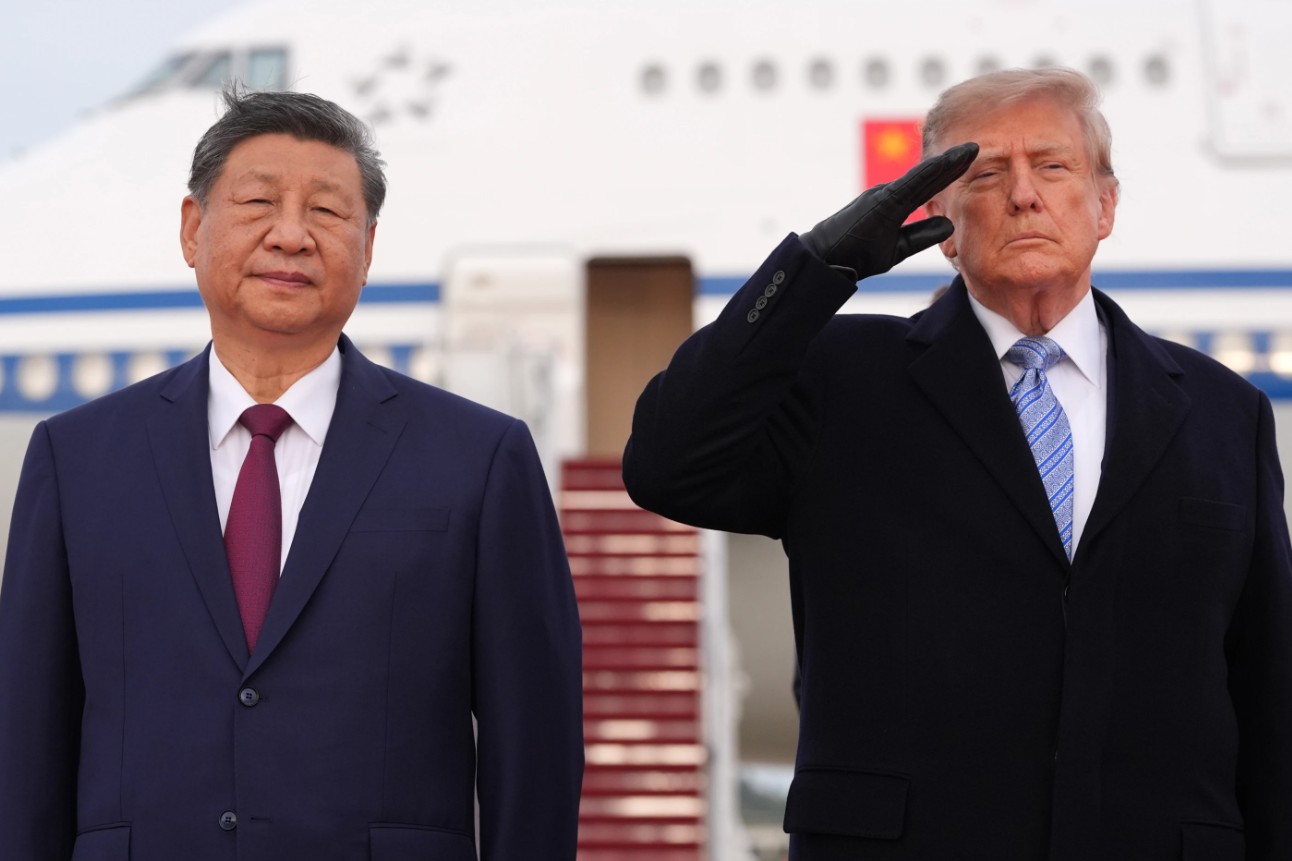
This narrative unfolded during the three-day Washington summit between President Trump and Chinese President Xi Jinping on Sept. 23-25. Both leaders toasted a future of harmony alongside tech CEOs like Sam Altman and Jensen Huang. Meanwhile, a quiet semantic mandate was setting a regulatory time bomb.
At the summit, the White House confirmed that Trump successfully pressured the Chinese delegation to replace “artificial intelligence” with “super intelligence” in bilateral talks. On the White House South Lawn, Trump defended the mandatory shift.
“I call it SI because it’s a much better name,” Trump said. “Artificial means it’s fake, and it’s not fake.”
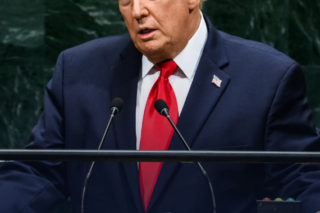
Days prior, Trump took these exact words to the United Nations General Assembly. His statement transformed a simple preference into a global diplomatic requirement.
Competing paths to innovation
While Beijing accommodated the phrasing in bilateral discussions, China’s Ministry of Foreign Affairs maintained that they simply understand the U.S. usage of the term rather than officially adopting it. Trump explicitly stated that a new name does not alter the competitive stakes. The U.S. president seeks to flatly reject any international guardrails that would slow American progress.
“The United States of America is not going to be putting on brakes,” Trump told reporters. According to Trump during press availability, the U.S. leads China in advanced AI development by up to two years. He asserted that his administration has no intention of opening up or integrating systems with competitors.
Xi countered by emphasizing that leading nations have a responsibility to keep tech under strict human control.
This creates a disconnect between the terminology used by the scientific community and the framing co-opted by the White House. Because the U.S. framework departs from established global standards, multinational tech companies could face immediate complications with compliance.
The legal rules governing software change the moment it crosses an ocean. If the U.S. eventually encodes SI into legal language, multinational tech companies, from frontier labs like OpenAI and Anthropic to infrastructure and platform giants like Nvidia and Meta, will face complications with compliance. Forcing today’s commercial tools into an “SI” label directly clashes with the hard-coded language of the European Union (EU) AI Act and China’s domestic frameworks.
The view from the academic ground
Dr. Hye Ryeon Jang, Professor of Political Science at Morehouse College, points out that the rebrand stems from Executive Order 14434. However, she simultaneously notes it remains an uncodified presidential initiative rather than officially adopted federal law.
“We also need to make a distinction that it looks like they sort of agreed, but it’s not really a clear agreement on terminology,” Jang explains, analyzing the subtle friction between the White House and Beijing’s foreign ministry.
“The United States says they both agreed upon it, versus China saying, ‘we understand your usage of the new term.’ European countries and a lot of developed East Asian countries which are leading on AI, they still really prefer to use the term AI with artificial intelligence.”
Jang emphasizes that this linguistic gap highlights fundamentally competing philosophies on safety. Washington is chasing an unregulated technical edge while the EU and China favor stricter regulation.
“They really wanted to develop cutting-edge technology without thinking about the consequences,” Jang said regarding Washington’s motivations. “…It may cause some conflicts in the future,” she warns.
This fracturing of terminology is a strategic calculation, according to emerging student political analysts at Morehouse College. Acie Abner, a senior political science major studying Chinese politics, weighs in on how Beijing views the American semantic mandate.
“Going along with things like Trump calling it super AI… continues that appearance of China as [being] somebody who’s easy to work with and also prevents any conflicts that would interrupt development internally,” Abner said, maintaining that Beijing will treat the change as a superficial concession while leaving its actual tech laws untouched.
Furthermore, a fragmented legal landscape could halt important international safety treaties. A senior political science major who preferred to stay nameless observes how separating technology from its global legal definitions invites new complications into international law.
“At this point, countries are just seeing this as a reality of what the current U.S. administration is going to do,” the student states.
He noted that midterm elections have a major role to play regarding international relations: “I think that [midterm elections] will determine if and when and how certain countries, especially in the EU, are going to begin to distance themselves from the United States. Especially if more Trump-aligned politicians become elected come November.”
Congress’ perspective
Democrats have responded to Trump’s rebranding, saying it and Trump are being foolish. Sen. Bernie Sanders (I-Vt.) explained that Trump is acting in accordance with his trend of not being informed before speaking. Trump’s decision to change AI’s name, Sanders argues, is ignorant of the broader issue at hand, establishing AI restrictive policy.
“I think he is mentally unbalanced,” Sanders said in an interview with The Independent. I think he has not a clue about the problems associated with uncontrolled AI.”
The name change also received backlash from other politicians like Sen. Lisa Murkowski (R-Alaska) who described Trump’s push for AI growth as a dangerous thing.
“You can call it different names, it still is going to present great opportunity and great challenges and potential threats,” Murkowski told The Independent.
An inheritance of leadership
For the Morehouse community, this battlefield of linguistics directly shapes the ethical and legal landscape the next generation of Black leaders will inherit. Justin Clopton, a senior political science major, considers how the shift alters public perception of the technology’s current limitations.
“When you hear ‘super,’ there’s immediately a positive connotation,” Clopton said. “Linguistically, it can be used to hide adverse effects on marginalized groups and the biases it picks up. AI works off existing literature, and in the status quo, a lot of the stuff out there is really ignorant of marginalized groups.”
In the digital landscape, true leadership will absolutely require cutting through the noise of this “Policy Babel.” Moving forward, the focus for future policymakers remains on enforcing structural equity and strict tech ethics. Coherent international law is a top priority for moving forward as nations in this increasingly tech-focused future.
The age of renaming and reclaiming has officially arrived. Morehouse students must ensure that they remember what these terms truly mean, and what they imply about the future.