




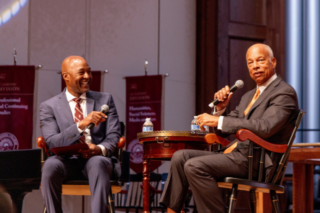

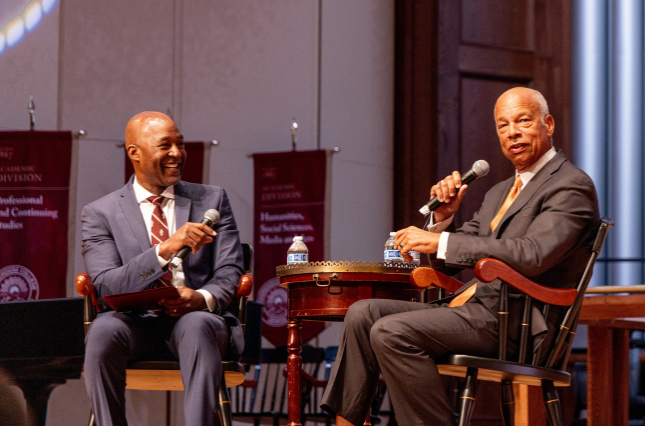
Former United States Secretary of Homeland Security Jeh Johnson ’79 returned to Morehouse College on Sep. 15, offering students an intimate look into a career shaped by law, national security and public service.
Johnson is a former federal prosecutor and the first Black partner at Paul, Weiss, Rifikind, Wharton & Garrison. He has held senior legal positions in the Clinton and Obama administrations before serving as secretary of homeland security from 2013 to 2017. His responsibilities ranged from advising military officials on national-security matters to overseeing immigration enforcement as a Cabinet secretary.
Inside the classroom
Before joining Morehouse President F. Dubois Bowman ‘92 for a conversation through the Presidential Speaker Series, Johnson met privately with a select group of 9 pre-law students. During the meeting, he used a law school-style Socratic discussion to challenge students with questions about national security, constitutional principles and individual rights.
Johnson placed students in the position of government officials responsible for making decisions with potentially life-or-death consequences.
Johnson presented students with a hypothetical scenario: Intelligence officials had identified a new leader of Al-Qaeda staying inside a hotel on U.S. soil. Students had limited time to determine how the government should respond.
The possibility of conducting a raid forced students to consider the legal and ethical consequences of government action. Johnson questioned them about many factors. This included the reliability of the intelligence, the potential danger to civilians, the suspect’s constitutional rights, and the legal limits on using military force within the United States.
The discussion encouraged students to examine what justice and a responsible exercise of government power should require. His exercise helped students think beyond just what the law might permit.
The exercise also reflected the types of high-stakes questions Johnson encountered as general counsel of the Department of Defense during the Obama administration. In that position, he helped shape the legal framework surrounding U.S. counterterrorism operations.
The House and beyond
Johnson’s return to campus marks 47 years since he graduated. A New Jersey native, he recalled living in Thurman Hall, now the Living Learning Center (LLC), and attending Morehouse College alongside Olympic gold medalist Edwin Moses ‘78
After graduating from Morehouse in 1979 and earning his law degree from Columbia University, Johnson built a career spanning private practice and three presidential administrations.
He served as an assistant U.S. attorney for the Southern District of New York before becoming the first Black partner at the law firm Paul, Weiss, Rifikind, Wharton & Garrison.
His career later took him into senior civilian roles within the military. Under President Bill Clinton, Johnson served as general counsel of the Department of the Air Force from 1998 to 2001. Johnson returned to government work during the Obama administration as general counsel of the Department of Defense from 2009 to 2012. He later served as the first Black secretary of Homeland Security from December 2013 until January 2017, overseeing one of the federal government’s largest departments.
Johnson’s Pentagon responsibilities also included military personnel policy. In 2010, he co-authored a report that helped pave the way for Congress to repeal “Don’t Ask, Don’t Tell,” the policy that prohibited gay and lesbian service members from serving openly.
While serving as secretary of homeland security, Johnson led approximately 230,000 personnel across 22 components. This position broadened his responsibilities from providing legal advice to directing one of the federal government’s largest departments.
Keeping the “micro image” in mind
During the event in King’s Chapel, Johnson described immigration and border enforcement as the most difficult responsibility he faced during his public-service career. As secretary, he had to make make broad policy decisions affecting the country, but he tried to remember the individuals who would experience their consequences.
While making decisions on a “macro” level, Johnson kept what he called the “micro image” in mind, particularly the image of children whose lives could be changed permanently by government policy.
That perspective influenced his response when family separation was presented to him as a possible way to deter immigration. Johnson said he rejected the proposal.
”A good leader is someone who is the best version of themselves and encourages others to be the best version of themselves,” Johnson said, recalling a lesson he learned from military leaders with whom he worked.
His reflections reinforced a central theme of the discussion of leadership: government leaders must consider the human consequences of their decisions, even when addressing problems on a national scale.
Leadership beyond a title
Johnson encouraged students in King’s Chapel to understand leadership as something deeper than holding a powerful position. His remarks emphasized that leadership is not measured by the scale of one’s authority, but by how responsibly that authority is exercised. His career from federal prosecutor and law-firm partner, to Pentagon attorney and Cabinet secretary, demonstrated how legal training can lead to responsibilities extending far beyond a courtroom.