

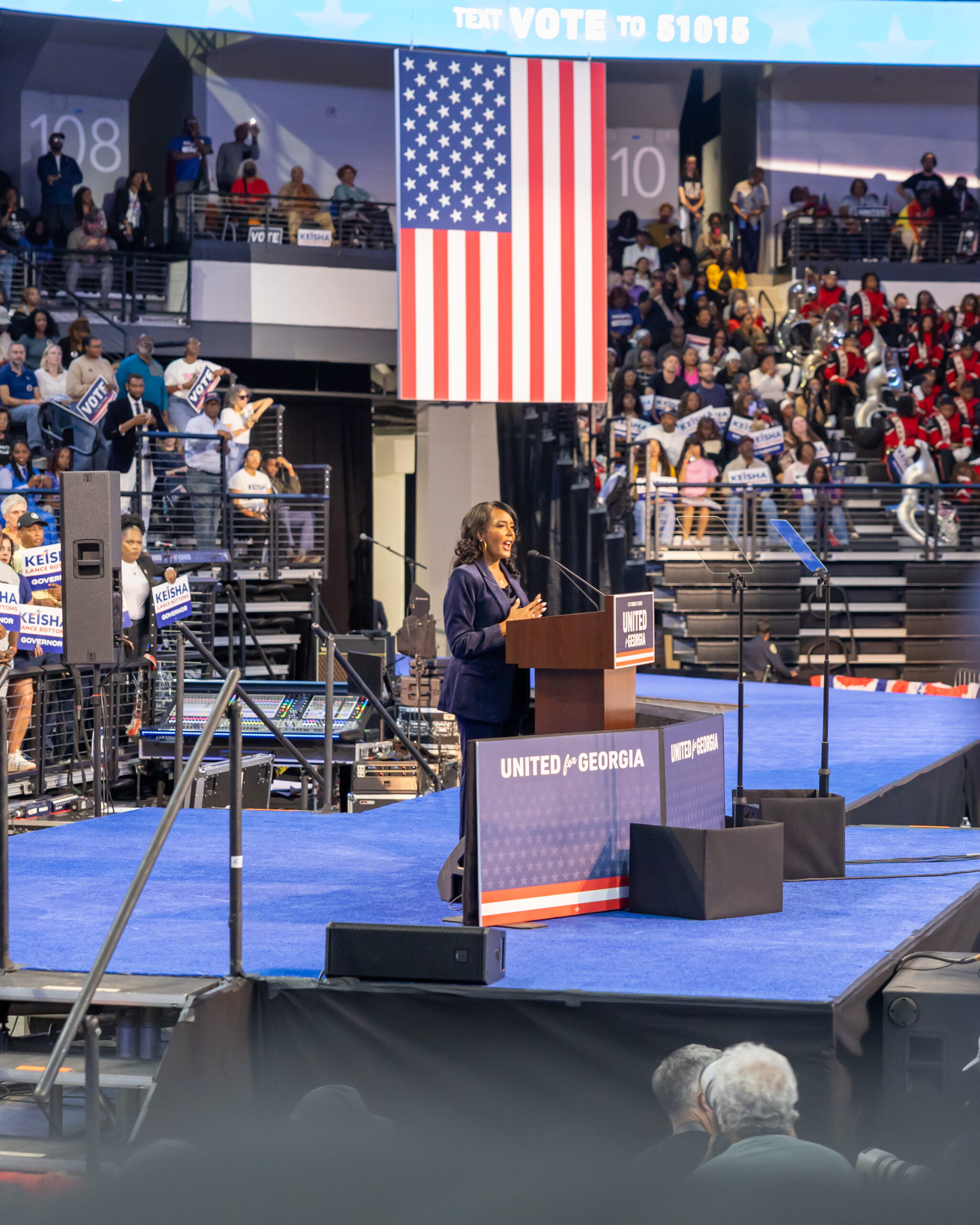
The race was called on Nov. 3 at 9:24 p.m., which is much earlier than most elections. The atmosphere of the Marriott Marquis located in downtown Atlanta was only a mere sample of the excitement statewide. The event hall could barely hold the guests as the line for access passes extended across the entire lobby floor. Everyone came in some of their best attire, sporting unmistakable blue diamond pins with the words, “Keisha Lance Bottoms for governor.”
Now, Bottoms will become Georgia’s first woman and first Black governor when she takes office in January, making her the first Black woman to serve as governor of any U.S. state.
She described her campaign as reaching every corner of the state, “from the red hills of Georgia to the Blue Ridge Mountains of the Piedmont,” as cameras crowded in to capture the moment.
Joining her onstage were her mother, her children and her husband, Derek Bottoms, whom she met while attending Georgia State University College of Law and married in October 1994.
Supporters who had campaigned alongside Bottoms for 578 days shed tears of joy at her election watch party. Among those near the stage were U.S. Sen. Raphael Warnock ‘91, D-Ga., the senior pastor of Ebenezer Baptist Church, and the Rev. Jamal Harrison Bryant ‘94, the senior pastor of New Birth Missionary Baptist Church.
Eight Black women, many firsts
In 2025, Black women experienced disproportionate employment losses as the Trump administration implemented federal workforce cuts and rolled back diversity, equity and inclusion initiatives.
The losses disproportionately affected Black women across the country. In 2026, Georgia voters elected eight Black women to statewide office, marking a historic shift in the state’s political leadership. The South had something to say.
Georgia’s eight major statewide executive offices are the governor, lieutenant governor, attorney general, secretary of state, agriculture commissioner, insurance commissioner, labor commissioner and state school superintendent.
When the newly elected officials take office in January, Black women will hold seven of Georgia’s eight statewide executive offices, a first for the state, with Lt. Gov.-elect Josh McLaurin holding the eighth seat.
Several broke barriers of their own. Tanya Miller will become Georgia’s first elected woman attorney general. Penny Brown Reynolds, a former Fulton County judge, will become the first Black person elected Georgia secretary of state. Keisha Sean Waites, a former Atlanta City Council member, will become Georgia’s first Black woman insurance commissioner. Educator Lydia Powell will become its first Black woman state school superintendent, while Nikki Porcher will become its first Black woman labor commissioner.
Agriculture Commissioner-elect Katherine Juhan-Arnold founded Baby Katie’s Pharm & Kitchen, a nonprofit farm that provides fresh produce and agricultural education to underserved communities. Shelia Edwards, who won the District 5 race, will join Alicia Johnson as one of only two Black women on the Georgia Public Service Commission. Johnson became the first Black woman elected to a statewide partisan office outside the judiciary in Georgia after winning her commission seat in 2025.
“Georgia chose competence,” Brown Reynolds told The 19th. “We were not selected because we were Black women. I believe that we were selected because all of us bring something that Georgia desperately needs.”
Andra Gillespie, a political science professor at Emory University, told USA Today that the number of Black women elected to leadership positions in Georgia is unprecedented.
“Black women have definitely reached a point where they can not only run and be taken seriously for leadership positions in major parties,” she said.
The wins reached Congress too. State Rep. Jasmine Clark, D-Ga, became the first Black woman with a doctorate in science elected to Congress, winning Georgia’s 13th Congressional District seat, while U.S. Reps. Lucy McBath and Nikema Williams won reelection.
“Georgia has shown up”
Warnock said Georgia voters showed the power of organizing this election cycle and pledged to keep fighting for historically Black colleges and universities.
“I’m proud of Georgia. Georgia has shown up,” Warnock said. “Some 3 million of them early voted.”
He said churches played a key role in that turnout.
“What we saw, among other things, in this election cycle is the power of organizing, and the faith community has always been an important part of that,” he said.
When asked about the legislative priorities he plans to pursue with Keisha Lance Bottoms, Warnock highlighted his efforts to secure federal funding for historically Black colleges and universities.
Warnock pointed to a recent $97.1 million federal award supporting STEM programs at 10 historically Black colleges and universities and other minority-serving institutions, including Clark Atlanta University. His office has also reported securing more than $17 billion for HBCUs nationwide since he began his full Senate term.
With Governor-Elect Bottoms being an HBCU graduate of Florida A&M University, Georgia will have two HBCU alumni representing the people of the state.
“My own life is a testament to how these schools perform way above their weight,” he said. “And so I’ll continue to fight for them.”
His advice for current students was simple: “Morehouse gave me everything I needed to get ready,” he said. “I want the students to look at someone like me, and many others in various fields, and know that we sat in those same desks that they sit in. And so the sky is the limit.”
“Money doesn’t make you a success; character does”
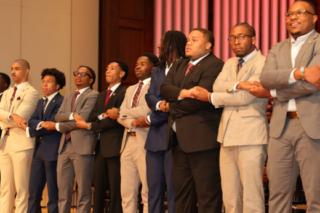
Bryant said the win was personal, crediting Black men and Black churches for helping elect Bottoms.
“Super excited to know history was made, and to know that Black men supported a Black woman to get to this place,” he said.
The biggest hurdle, Bryant said, was getting Black churches involved and engaged, which he described as a return to the church’s tradition from the civil rights movement.
His advice for young men at Morehouse and across Georgia was direct.
“The takeaway lesson for all of us is money doesn’t make you a success,” Bryant said. “Character does.”
When the officials-elect take office in January, Black women will lead nearly every corner of Georgia’s executive branch. Bottoms announced her transition team Friday, Nov. 6. She and the seven other statewide officials-elect will be sworn in in January.