



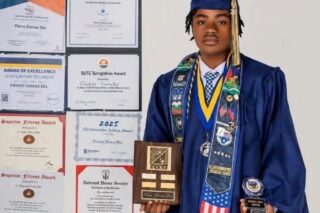



On Saturday, July 4, 2026, Nolan Wells was reported missing by Warren Hudson, a friend of his who travelled with him on a trip to Horn Island, a federally protected barrier island that sits five miles off the Mississippi Coast. Four days later, on July 8, Wells’ body was found on the western tip of Horn Island.
Wells embarked on a trip with his friends to celebrate the Fourth of July. They left for the island on a boat at approximately 10 a.m. There were roughly 24 people split between three boats. images show Wells was the only Black person on any of the boats.
The boat arrived back in the harbor at approximately 5:44 p.m. that same day. The only difference being that Nolan was not aboard.
Earlier that afternoon, the boat Wells was on made a call to the Mississippi Department of Marine Sources. The call was made by Warren Hudson to report that the bank had sunk and that the teens were in need of rescue. When the phone operator asked how many people were on the boat one of the teens responded by saying “…like seven” people. It was later revealed that none of them were over 21 years old.
Wells was first reported missing that night at 11 p.m. His parents were notified that their son had not returned with the rest of his friends. Furthermore, Wells’ friends also stated that Wells decided to stay behind on the island with an unidentified female.
Prior to Wells’ body being found on July 6, the sheriff’s department came out with a statement saying that “no foul play was suspected.” His statement further inflamed public outrage as many began to suspect foul play immediately after hearing about the case. Wells’ body was recovered on July 8. It was decided that an autopsy report would be necessary to determine an investigation of potential foul play.
On Sept. 21, a grand jury report came out of the Jackson County District Attorney’s Office. The report found that Wells’ body was consistent with that of death by drowning. They said there was no evidence of criminal wrongdoing found in the case. The District Attorney’s Office also reported that the bruise found on the back of Wells’ head was non-lethal. However, the cause of said injury remains unclear. No disease or fatal injuries were found on the body of Wells, according to the jury.
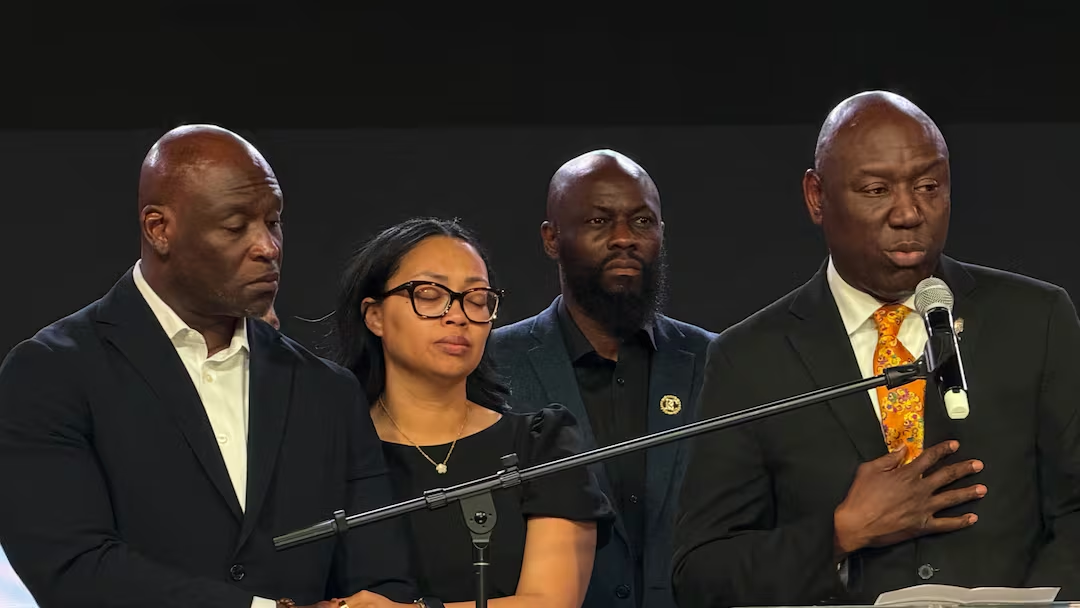
In the family’s press conference following the verdict, Wells’ mother, Christine Wonsley, gave an impassioned speech regarding the case. “Last night was a reminder that our son’s life does not matter to those who hold positions that are supposed to serve and protect the public. ” She would then also go on to declare that her and his family would continue to “…fight for justice.”
Morehouse NAACP responds
Morehouse College NAACP chapter president Ezekiel King ‘28, says the emotions experienced by the Wells family are familiar in the Black community.
“It’s unfortunate, but this was expected,” King said. “We know that a grave injustice has happened before the Black community. This sense of dread that we feel is all too common.”
King says he relates to how Wells may have felt during his final moments. He says he’d often move from state to state and struggled with being in classroom settings where he was the only Black student.
“If you haven’t really been in a situation like that, you wouldn’t really understand just the kind of subtle cruelty that a lot of Black kids and young people who are in these sorts of white spaces feel,” King said.
King encourages Atlanta University Center students to get involved in spaces where they can make a difference so that other Black teens don’t have to suffer the same fate as Wells.
“There are people on this campus who I truly believe will go into the world and do great things for our people,” he said. “Yes, it’s unfortunate, but it’s a long fight that we have to fight.”
The history of lynching
Dr. Ovell Hamilton ‘93, the Chair of the Africana Studies department at Morehouse College, explained, similarly to King, how the Wells case relates to his own life.
In the 2010s a member of Dr. Hamilton’s family embarked on a similar trip to Nolan Wells as one of the few Black people in the group. That person ended up drowning in a similar circumstance to Wells. Hamilton explained that when he heard the news about Wells it “brought back memories…” for him and his family.
Instances like these bring conversations surrounding lynching to the surface.
Ida B. Wells-Barnett was an investigative reporter, a position that stood as one of her crowning achievements in her career. She was one of the first people to conduct an investigation regarding lynching in the United States. Wells-Barnett also made contributions as a feminist scholar, civil and women’s rights activist. In “On Lynchings,” Wells-Barnett used data and journalistic accounts to disprove social myths surrounding Black men and lynching.
According to Wells-Barnett in 1894, she discovered that 197 people were “…put to death by mobs.” State-sanctioned executions numbered 132 by her account as well. Wells-Barnett records that Tennessee, Missouri, Alabama, Texas and Houston held five accounts of lynchings that went uninvestigated in 1893. This explicates her point that lynching had become normal. It was to the point that to find “…the dead body of a Negro…” hanging from a tree was not itself worthy of attention or criminal investigation.
The period where lynching was the most prominent is referred to as the Nadir period, analogous to the “lowest point” in African American history. The period spanned from approximately 1890-1920, during which activists like Ida B. Wells-Barnett and those at the NAACP recorded these injustices in an effort to create a formal anti-lynching bill, which ultimately, never came to fruition.
Hamilton describes lynching as a “…murderous, illegal act, designed to instill terror, and also designed for mob vigilante, mob justice.”
Still, many are left to think about what this information means for the future of Wells’ case.
Will it spur them to take corrective and restorative action or will it remain just as it is in this article, words on a page?