








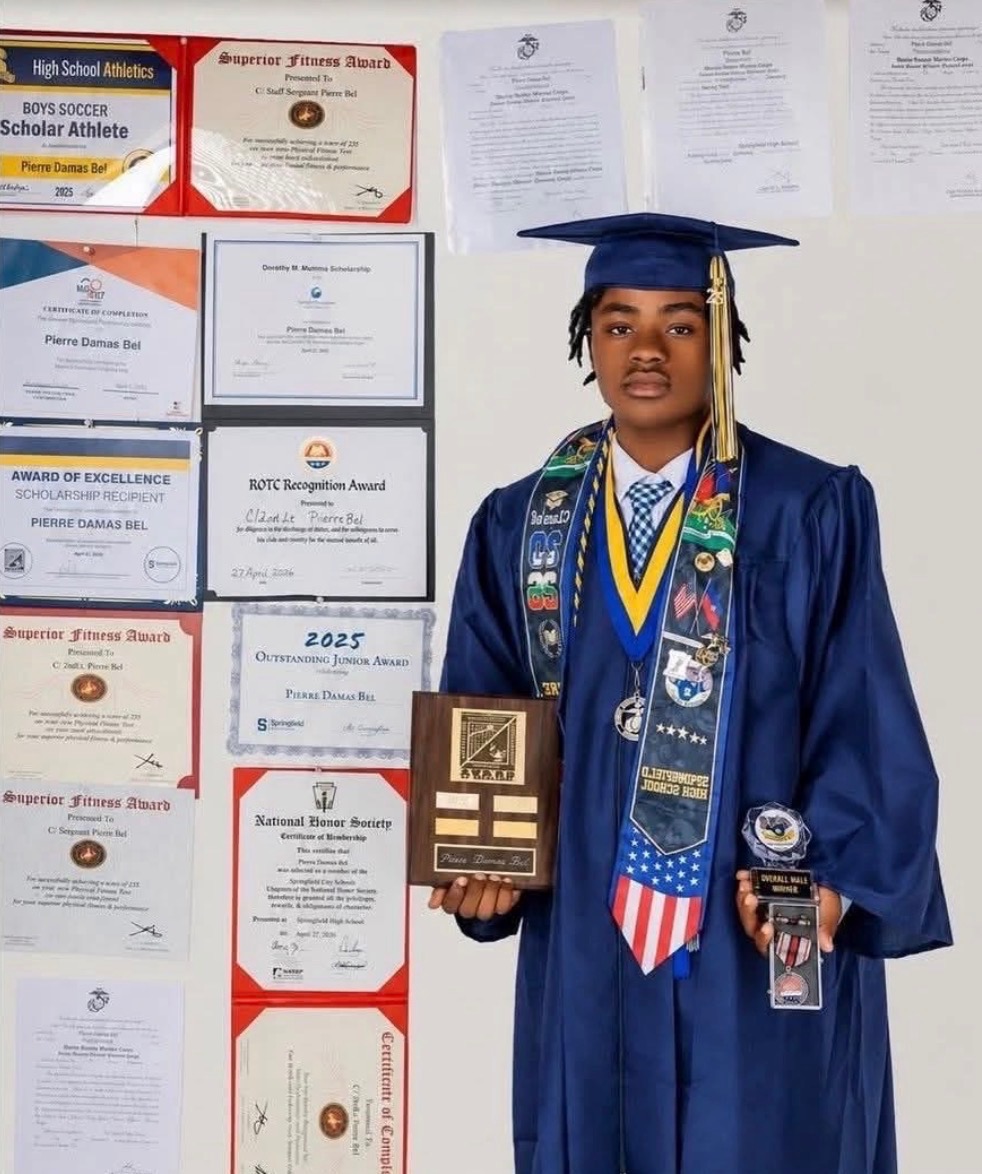
Pierre Damas Bel, a 20-year-old Haitian Immigrant and Wright State University student, died Aug. 31 after being struck by a tractor-trailer on interstate 7- in Clark County, Ohio.
Pierre Damas Bel’s family says he experienced bullying and psychological distress after ICE fitted him with a GPS ankle monitor.
The Ohio State Highway Patrol and the local coroner continue to investigate the circumstances surrounding his death. Bel’s family and community advocates believe he died by suicide following distress they associate with the ankle monitor placed on him and alleged bullying he experienced while wearing it.
Bel discussed the monitor in an Instagram post on July 30, a month before he lost his life.
”I came to this country to pursue my education. I didn’t come here to commit a crime or hurt anyone,” Bel wrote. “Yet now I’m walking through the streets of the United States with a GPS monitor on my leg, carrying a feeling of shame and humiliation that I never imagined I would experience.”
From Haiti to Wright State
Bel immigrated to the United States from Haiti in 2024. He graduated with honors from Springfield High School in May, where he participated in JROTC and played soccer.
He recently began his first semester at Wright State University, where he studied neuroscience and planned to participate in the soccer club. Bel hoped to attend medical school after completing his undergraduate education.
According to ICE, Bel entered the United States through an official U.S border crossing on March 5, 2024 for an appointment through CBP One, a federal mobile app used to arrange immigration processing, and was released while his immigration case proceeded.
ICE monitoring and allegations of bullying
On July 29, ICE placed Bel in its Alternatives to Detention program and fitted him with the ankle monitor while his immigration proceedings continued.
ICE described Alternatives to Detention as a program that permits immigrants to remain in their communities while their cases move through the immigration system.
In a written statement released through G92, a faith-based organization that works with Springfield’s Haitian community, Bel’s father, Pierre Ronal Bel, said the monitor negatively affected his son’s experience at school.
”After my son was outfitted with the ankle monitor, he felt like he was treated like an animal,” his father wrote.
His father said Bel experienced severe bullying and was denied a JROTC uniform while other members received theirs. He also said Bel made multiple visits to immigration offices asking officers to remove the monitor, but ICE kept it in place.
According to a Sept. 1 report by WSYX,Wright State said it had no confirming information regarding complaints or investigations into the alleged bullying.
Temporary protected status ends for Haiti
Bel’s placement in the monitoring program came shortly after changes to Temporary Protected Status (TPS) for Haitian nationals.
TPS allows eligible immigrants from countries affected by armed conflict, natural disasters or other extraordinary conditions to live and work temporarily in the United States. Haiti first received designation following the country’s devastating 2010 earthquake.
The Trump administration moved to terminate Haiti’s designation as part of its broader immigration enforcement agenda. On June 25, 2026, the Supreme Court ruled 6-3 in Mulin v. Doe, allowing the administration to proceed with terminating TPS for Haiti and Syria. “The TPS statute plainly bars consideration of respondents’ non-constitutional claims,” Justice Samuel Alito wrote. The court concluded that the challengers were not entitled to orders postponing the terminations during litigation. Haiti’s TPS designation officially ended July, 2, placing hundreds of thousands of Haitian immigrants at risk of losing their authorization to live and work in the United States.
The policy change was especially significant in Springfield, which has become home to thousands of Haitian Immigrants in recent years.
Final call and ongoing investigation
Bel’s father said his son called him by video at 8:03 a.m. on the morning of his death.
”He said, ‘Dad, I’m not feeling OK. I’m not thinking right because of the bullies,’” his father recalled.
He told his son to return home so they could talk. Later that morning, police arrived at the family’s home to notify them of his death.
The Ohio State Highway Patrol said troopers responded at approximately 8:45 a.m. to Interstate 70 near Harmony Township. Investigators said Bel’s car was parked on the highway’s shoulder before he entered the westbound lanes and was struck by a tractor-trailer.
Bel was pronounced dead at the scene. The truck driver was not injured.
ICE confirmed that Bel was enrolled in Alternatives to Detention at the time of his death but rejected claims that the agency was responsible.
”The circumstances of his death remain under investigation by OSHP,” ICE said in a statement reported by Dayton 24/7 Now on Sept. 1. “ICE does not comment on the cause of death while that investigation is pending.”
Officials and Community members respond
Wright State University President Sue Edwards said the university was “heartbroken by this devastating loss.”
Ohio Governor Mike DeWine called Bel’s death a “horrible, horrible tragedy” and reiterated his opposition to the federal government’s mass-deportation policy. DeWine also questioned the decision to place Bel under electronic monitoring.
Community organizations have held vigils in Bel’s memory and called for changes to the government’s use of ankle monitors. His death remains under investigation.
If you or someone you know is experiencing emotional distress or considering suicide, call or text the 988 Suicide & Crisis Lifeline. Support is available 24 hours a day.