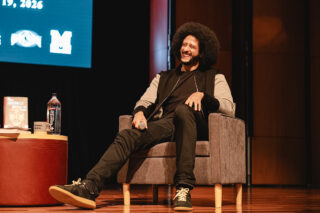





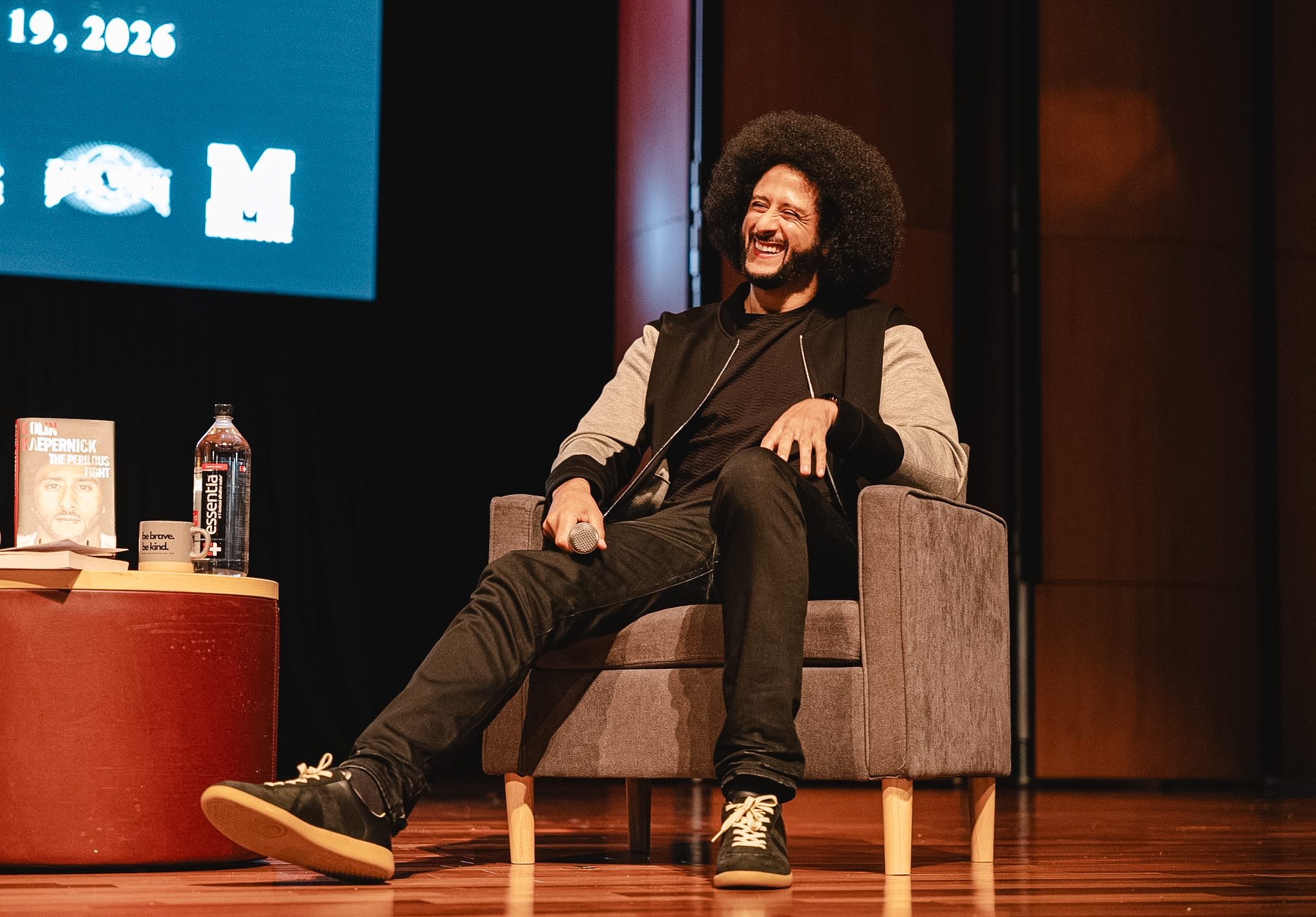
Nearly a decade after Colin Kaepernick first knelt during the national anthem to protest racial injustice, he is still wrestling with a question that has followed him since 2016: When do you respond to your critics, and when do you keep the focus on the cause?
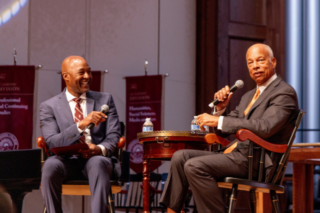
“Do I respond how I personally want to,” he said in an interview with Grits and Eggs Podcast host Deante Kyle at the Ray Charles Performing Arts Center on Sept. 19. “Or do I just keep the focus on the movement and on the issues we’re trying to address?”
Now as an activist, entrepreneur and author, Kaepernick decided to pick up the pen and write his own story about his activism from 2016 through his perspective in his latest book “The Perilous Fight.”
The five-time author and all-time leader for rushing yards by an NFL quarterback takes readers through his upbringing in Turlock, California, struggles with racial identity during his childhood, his rise to the NFL, his 2016 protest and the fallout that followed after he became a free agent in 2017.
Far from the first instance of national anthem protest, Kaepernick joined the ranks of athletes like John Carlos and Tommie Smith when he initially chose to sit out of the national anthem in August 2016.
After consulting with former NFL player and United States Army Green Beret Nate Boyer, Kaepernick changed his protest by taking a knee during the preseason game between the San Francisco 49ers and the San Diego Chargers on Sept. 1, 2016.
Described by Kaepernick as “equal parts memoir and manifesto,” “The Perilous Fight” is an expansion on the depictions of his upbringing in books such as “I Color Myself Different” and “Colin Kaepernick: Change the Game.”
In publishing this book, Kaepernick seeks to empower readers to overcome power structures similar to the ones he faced in the NFL.
As an example of how wealthy owners use their resources to advance political causes, Kaepernick pointed to Patriots owner Robert Kraft and his financial support of pro-Israel organizations.
“What we see is this ownership class within the NFL, but also this ownership class across the United States, willing to wield their power to their own self-interest and to the detriment of the people,” Kaepernick said.
Kaepernick said his understanding of race and power began developing during childhood. As a Black child adopted by white parents, he said he experienced racial dynamics differently from the family raising him.
“It gave me a great understanding of how the U.S. would respond to protests like this,” he said. “We have the historical context. We’ve seen this play out, whether it’s Malcolm X, Martin Luther King Jr., whether it’s the Black Power movement…We’ve seen the response of Black America in relation to Black protests.”
Empowered by Black literature and leadership
Books helped shape Kaepernick’s political thinking long before he took a knee.
He said reading “The Autobiography of Malcolm X” in 2015 deepened his understanding of race and social issues, while William Rhoden’s “Forty Million Dollar Slaves” reinforced his views about the power dynamics between professional athletes and team owners.
Kaepernick sees the NFL as an example of an institution utilizing their financial influence on players to make decisions that suit the league’s interests.
“This paycheck is telling you to look out for yourself,” he said. “And if you don’t…the same paycheck is going to be used against you to say ‘We’ll take this away if you keep talking. We’ll take this away if you keep going down this path.’”
Another influence behind Kaepernick’s activism was Dr. Harry Edwards, a founder of the Olympic Project for Human Rights (OPHR). Edwards introduced Kaepernick to the historical context behind athletes engaged in activism and the cost his protest would have on his athletic career.
Kaepernick sees young athletes struggle with that same dilemma today and emphasizes that they have the right to excel as an athlete while still contributing to their communities.
“We are multifaceted. We are multi-dimensional. We are able to be great at multiple things,” he said.
Opposition from within
Kaepernick also criticized the NFL Players Association, saying the union failed to advocate for him at critical points during his career. The union has publicly disputed that characterization, saying in 2019 that it had “continuously supported” Kaepernick and Eric Reid and worked with their attorneys during the collusion case.
Kaepernick said he injured his labrum, ulnar collateral ligament and left knee, 49ers medical staff recorded the injuries as contusions.
Kaepernick said he went to the NFLPA for assistance, only to be told “there’s really not anything we can do for you.”
The NFLPA failed Kaepernick, he said, again when he had filed a collusion grievance against the NFL.
“They do not want to challenge the NFL,” Kaepernick said. “In many instances, they’re actually working in collaboration with them.”
Since then, Kaepernick’s focus has shifted towards literacy and entrepreneurship. Through Kaepernick Publishing, he publishes written work with the intention to develop subject matter expertise for those who want to make a difference.
“I think there is a premium on literacy right now,” he said. “If we are going to be politically active, if we are going to advance our communities, we not only have to be literate, but we have to be well educated on the topic and subject matters that we’re trying to address.”
As Kaepernick continues his work, he says others can join him by looking to one another for collaboration while embracing the challenges that lie ahead in pursuit of a better future for all.
“You need to get people to internalize the struggle,” he said. “We have to be able to educate people, to get them to understand why this action is important and why it needs to be taken now.”